
Author: Byron Darden

Reducing Stress

There are coping skills based on evidence that we can draw upon to turn the tide, help us overcome the overwhelm, and get us back on track. Here are some suggestions. 

Just Breathe

Breathing exercises are a powerful way to combat what is getting in your way of recovery. Different ways of breathing can provide us with the stress reduction we need to help our thinking simply by reoxygenating the blood. Not just for our bodies, breathing techniques and also for our brains. Fresh oxygen to the brain helps clear the cloudiness and provides what our brain needs most. Shortness of breath can be a major factor in contributing to the overwhelm that leads to the fear of the unknown. 

Get Social

Expanding our social connections with others is another way to deal with what is happening to our being that can plague our performance. I know for myself that when I feel this way, I tend not to be as social. I’ve learned to change that mindset and get out among people. You might very well come across someone else who’s having a difficult time. Just because you made the effort and found them, the connection could be just what you both needed to heal. The old saying, ‘misery loves company’ is not my favorite way to look at it and yet, there is comfort in the sentiment considering how much more effectively we deal with anxiety when we discover we are not the only one. 

Trust Yourself

Demonstrating self-compassion is another antidote to overcome the sometimes debilitating impact of facing change. In my February 2022 blog on Restorative Self-Care, I map out ways you can develop your practice of self-compassion. 

Write it Out

Journaling is yet another useful tool in getting back on track. I urge all of my clients at the start of every coaching engagement to start and maintain a leadership journal. It is a powerful way to gain insight and support from within, from which all our needs can be met with a little practice and discipline. 

One of the most helpful ways to journal is not by typing, but rather by picking up a pen and paper. A direct connection between the body and heart comes from the physical act of writing, for which a keyboard relationship becomes a wall between you and your inner self. As much as I value my keyboard to write – when it comes to journaling, writing is a therapeutic activity in and of itself. 

Read about My Reaction to Change.
Reframing Your Beliefs

Reframe by Byron Darden

Changing often involves rewriting the stories we’ve been told or lessons we’ve been taught. You’ve probably heard the saying “money doesn’t grow on trees”, meaning that there are finite financial resources and that you’ll need to work hard and say no to a lot of things and experiences to be successful in life when defined by the amount of money you have. This phrase limits your beliefs about abundance. Here are some more examples of well-known phrases and alternative ways to reframe these beliefs:

Instead of Consider This
At the end of the dayWhen the sun sets
Think outside the boxPush the walls of the box out
Bring to the tableShare your thoughts
Break down the silosWork together
Ducks in a rowCome prepared
Push the envelopeTest the limits
Pain PointChallenge
Circle BackLet’s Revisit This
Keep Me in the LoopProvide regular updates 
On my RadarIn my Focus

Reframing is a useful approach when you are feeling stuck. It allows you to imagine a larger variety of outcomes, and connect with others on a different level. Reframing allows you to shift from a mindset of judgment to one of curiosity. Once you get a different perspective on change, you can adapt to it more easily.

Keep reading to discover ways to Reduce Stress.

Change Factors

Fear of Change by Byron Darden

The fear of change, known as metathesiophobia or neophobia, is the discomfort or anxiety people feel when they anticipate alterations in their familiar environment or routines. It’s a common human reaction as change often brings uncertainty and the unknown, causing unease.

This fear can appear in different ways, from mild discomfort to intense anxiety. When we fear change, we may resist or avoid new elements in our lives or systems of which we are a part. We may be driven by a desire to maintain the current state because we fear negative outcomes.

The fear of change is a complex emotion influenced by personal experiences, personality traits, cultural background, indoctrination, and the nature of the change itself. Understanding and addressing this fear is crucial for personal development, organizational management, and societal progress since change is a constant and inevitable part of life.

This fear of the unknown is often rooted in various factors:

  • Stepping Outside one’s comfort zone: A key principle in my coaching as I’ve been coaching clients to do this for over 20 years. Learning from years of examples too numerous to count, I’ve discovered that doing so allows us to grow and develop new skills, ways of thinking, and approaches to problem-solving. Stirring things up serves as a path through transitions. 
  • Loss of control is a fascinating concept given the only thing we have control of is our response to life as it happens. Even though I know this all too well, I still get caught up in the ‘need to control’ mindset which I find is an ineffective use of time and energy.
  • Fear of failure can stop us mostly because of our belief that we are unworthy. Nothing could be further from the truth. It would be great to have the opportunity to sit down with a group of close friends and have them remind us why they are in our lives. Should failure be true, why would they stick around? I recall the 1991 movie Soapdish when Sally Field’s character, Maggie, the actress, conspired with one of her friends to go to the local mall and pretend to be a fan who spots her on the escalator, making a big deal about the star being out in public. It was a boost to her ego and emotional grounding that afforded her the ability to return to her life with more confidence.
  • Lack of confidence is a constant companion we learn to shake over and over again. It is a process much like learning to figure skate or learning to meditate. It is through repetition that we learn to master whatever it is we wish to accomplish. It can be seen as a test of our ability to overcome discomfort. Yet the road to overcome discomfort is to feel the fear and do it anyway. Much the same way, we will find discomfort in healing and feel discomfort should we choose not to heal. Either way, there will be discomfort. The difference is how that discomfort will grow in negative ways should we choose not to heal. 
  • Break in routine or predictability is not easy for most of us. We find this in the patterns we develop neurologically as the synapses connect our patterns of thinking, behaving, speaking, and reacting to any one of these or all four.
  • Loss or change of social dynamics is something anyone experiences from time to time, particularly when we move from one geographical location to another. I know this for myself to be true as I’ve lived in nine different places in my life. 
  • Past trauma can trigger the fight, flight, freeze, fawn, or friend reactions. I urge you to explore our January 2024 blog on Trauma.
  • Cultural factors can play a role in adapting to change, especially when the change goes against our cultural norms.
  • Overwhelm is a recognized response to dealing with the fear that comes with the unknown. I speak to this in my November 2023 blog on Leadership and Resilience. What can be comforting in the midst of one’s overwhelm is the fact that the breakdowns we face when things get tough at the office or at home are evidence that a breakthrough is about to occur. When you think about it, our entire being is responding to what is happening to us. Which is significantly informed by our neurological patterns that sometimes send us down the rabbit hole of anxiety.
  • Uncertainty about the future is a concern for many of us . The best advice I can give here is to keep learning and growing and focus on the present while preparing for the future. Action might involve continuing education and networking to ensure you are aware of opportunities.

Click here to learn how to Reframe Your Beliefs.

The Role of the Brain

Change involves facing the unknown. As human beings, we like the familiar. It offers a sense of security. Even when we can clearly see that the grass is greener on the other side of the fence, we stay in our lane because we know what to expect. 

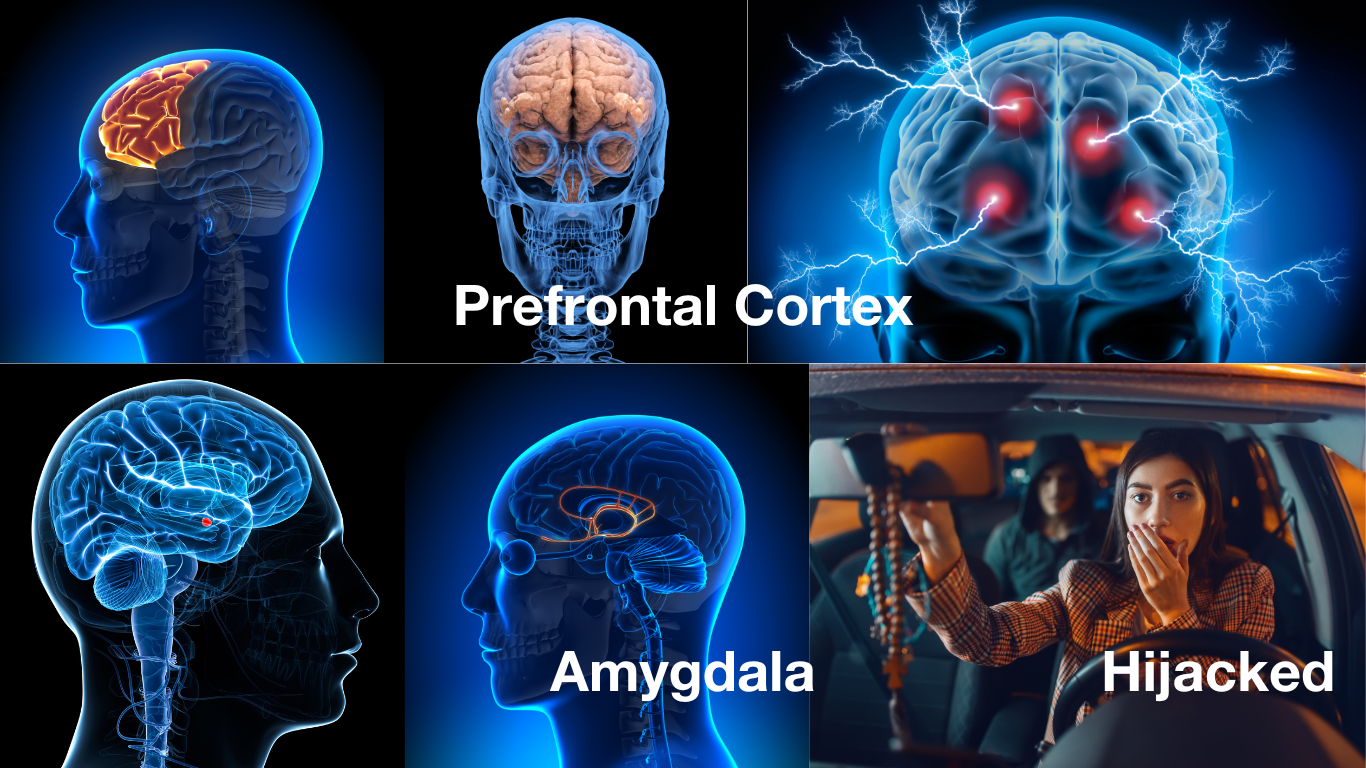
The neuroscience of change involves examining how the brain reacts to and deals with shifts in the environment. When change occurs, different parts of the brain, like the prefrontal cortex and amygdala, come into action. The prefrontal cortex assesses the new situation and potential benefits, while the amygdala, responsible for emotions, may trigger feelings of fear or anxiety due to uncertainty. 

The brain’s ability to reorganize itself, known as neuroplasticity, is crucial for adapting to change by forming new connections and acquiring skills needed for new situations. Understanding this neuroscience can help develop strategies to manage resistance, improve adaptability, and encourage positive responses during times of transition.

Curious as to why you might fear change? Keep reading to learn about Change Factors.

Breaking Patterns: The Neuroscience of Facing Change

Change is inevitable. At times, it is welcomed. At other times, it comes unexpectedly. The key is how we react to it. We base our actions on past experiences and our parents are often models for our behavior. The fact that your parents may have gone to college and worked a corporate job likely influenced your choice of profession. They may have set overt expectations or disapproved of your unconventional choice. 

Today’s job market and career possibilities are vastly different than when past generations entered the job market. Gone are the days when one started their career with one company and stayed until retirement. Enter times of uncertainty where one will likely change jobs and careers several times between age 18 and retirement. I have experienced this in my career – from professional ice skater to executive coach (and a few more deviations in between). I’ve experienced a lot of change and made numerous transitions.

In this blog, we will talk about facing change and what we can do when faced with modifying or altering the current state. We can embrace it and work through the discomfort, run from it, or freeze and stay with the status quo. 

Why do we fear change and how can we push through to achieve our purpose and goals?

Next up – The Role of the Brain in change.

Founders Corner – Breaking Patterns

“We all require and want respect, man or woman, Black or White. It’s our basic human right.” These are the words from singer, songwriter and pianist, the late Aretha Franklin. Her music can often be heard coming from my classroom wherever in the world I’m developing leaders.

We begin February celebrating Black History month. We are also celebrating American Heart Month, Cancer Prevention Month, Valentine’s Day, and Self-Check Month. Also later in February we are celebrating National Entrepreneurship Week.

What’s the significance of these celebrations to Triple Axel Executive Coaching? Each celebration speaks to the anniversary of our February 2022 blog on Restorative Self-Care.

Here at Triple Axel Executive Coaching we urge you to tend to your heart, prevent cancer, love others and yourselves this valentines with a restorative self-care, self-check!

Hi, I’m Byron Darden welcoming you to another edition of Leading with Purpose on Purpose. In this installment of our continuing series on Transition our focus is on Breaking Patterns: The Neuroscience of Facing Change

The one constant in all our lives is change. So we’ll take deeper dive into how we’ve come to resist change. Then explore how to manage it more effectively and hopefully minimizing being triggered by it when change presents its inevitable face. Enjoy.

This month’s blog begins with Breaking Patterns: The Neuroscience of Facing Change.

Unearth and Move Forward

“There will be obstacles. There will be doubters. There will be mistakes. But with hard work, there are no limits.”  –Michael Phelps

You’ve probably heard stories of leaders who faced adversity either in childhood or during the course of serving their company. They come from tough childhoods, drop out of college, or face bankruptcy. They didn’t let that stop them. They persevered and became leaders in their industry.  Some examples, are Colonel Sanders, Oprah Winfrey, JK Rowling, Michael Jordan, and so many more.

At Triple Axel, we focus on overcoming obstacles and helping you become the next great leader. A big part of that is providing tools to move past what is holding you back, and that includes healing trauma.

Scheduling a coaching session can unearth a level of awareness that will put you on the path to success. Book a session with Byron today and start your journey past fight or flight to conscious leadership.

Creating a Trauma-Aware Workplace

According to the US Department of Veterans Affairs, 6 in 10 men and 5 in 10 women will experience some sort of trauma in their lives.  Moreover, most of us will experience a trauma that could lead to PTSD.  

Of those who experience trauma, 70-90 percent of individuals will not do the work to move past their trauma.  Less than 30% of individuals will take the steps to manage their adversity and 5% of individuals truly take the time to heal from their traumas and harness their true potential.  I truly believe it’s that 5% that become leaders that others look up to.  Those leaders are tough, yet vulnerable.  They possess a presence that encourages others to listen and follow.  They provide hope for a fruitful future.

Most importantly, these 5% recognize the need for trauma-aware workplaces.  Here are some ways to create a trauma-informed workplace:

  • Provide opportunities to learn about trauma and how to act around each other.
  • Create a workplace culture that prioritizes safety, trust, and open communication.
  • Practice empathy and compassion – learn what to say and do when confronted with someone experiencing the effects of trauma.
  • Provide and promote resources such as counseling, employee assistance programs, or mental health support.
  • Be flexible and accommodating for team members who need support.
  • Promote self-care in the workplace and a work/life balance.
  • Address or minimize triggers in the workplace.
  • Assess what is working and adapt policies to address weak points.

Lessons From Life

I was reading the book Working With Emotional Intelligence by Daniel Goldman and read an account of a senior leader who was rather cross with the staff he led. 

There was so much commotion in the room with the leader ranting about some issue they were having when one of the team members calmly shared a different perspective. It took a great deal of courage for this individual to speak up. When they did, the senior leader seemed to speak over the staff member and that person continued in a calm and focused manner to state their case. Eventually, the senior leader acquiesced and allowed the individual to share their perspective. 

When I read the account I recalled what I had learned in meditation and wondered whether or not this person had meditation as a practice in their lives that allowed them to manage the volatile situation at hand. 

Similarly, I was teaching a group of junior consultants in a firm about developing their personal presence when a senior leader walked into the room and admonished one of their underlings for taking time away from work to attend such a class. 

The leader inquired about the topic of the class and the junior consultant responded about deepening their learning about presence. The senior leader scoffed, “I can teach you that in just a few minutes, and then you can get back to work.” The senior leader then closed the door and left.

I found that to be a disruptive and counterproductive act in front of the group considering their goals, particularly for me as a coach and for the junior consultant to whom the comment was made. I was also quite shocked that someone, particularly a senior leader at the firm, would do such a thing. I remember asking who that was and then excused myself from the class and followed the senior leader to their office. I calmly expressed my displeasure with what they just did and shared my concern that while possibly humorous to them, it was destructive to what I was there to accomplish for the sake of the organization. The senior leader was clearly caught off guard and apologized. 

When I returned to the class, they asked what had happened and I told them. You could have heard a pin drop in the room for the remainder of the training. The lesson learned is that there is a way to stand your ground when you are calm and collected rather than allow an amygdala hijack to render you ineffective in handling challenging situations.

I began my meditative practice at the age of thirteen when I began practicing my compulsory school figures as an ice skater. I did not know it at the time, though I believe my coaches knew what they were doing when practice time began with Hawaiian music that inspired my body to move in smooth and deliberately focused ways that allowed me to master the art of figure skating. That training prepared me well for an incident that took place many years later when I was living in Boston.

I arrive home in the middle of the day. Dressed in khakis, a blue button-down shirt, with penny loafers on my feet. A very New England look at the time. There is a torn screen door on the front of my home. Another on the back door. I plan to remove the screens. Time to take them both in for repair. It’s a bit warm, so I take off my shirt leaving me with just an undershirt to stay cool without changing entirely before moving on to the repair shop. 

I complete the effort of taking off the screen at the front of the property, the door propped open to allow the breeze to move easily through the house. I move to the back door, repeating the removal there as well, sweat beginning to run down my back. Suddenly a police officer appears in my backyard, hand on his gun, questioning a report he received from a neighbor that someone was taking screens off the doors of my house. I confirmed that was exactly what I was doing. He asks who I am in relation to the property. “This is my house and I am taking screens off the doors. Would you like to see my identification to confirm? It is sitting on the kitchen counter. Is it alright that I go and get it? Or do you wish to accompany me to do so?” A bit shaken, the police officer begins to relax and expresses his trust that I am safe to move out of his sight. 

Frankly, I was surprised by his response. Having grown up with an attorney for a father and having traveled with him a few times to get depositions from incarcerated defendants that he represented, I knew the lay of the land in managing law enforcement. I remained calm and respectful of his authority, having grown up to carry a slight fear of police when it comes to being a man of color. This is no time for an amygdala hijack!

I return with my identification to show the police officer that I indeed reside at this residence. He is satisfied that all is well when I calmly and matter-of-factly ask which neighbor was kind enough to look out for the safety of our neighbors. I want to express my gratitude that they are looking out for those of us on our block.

Typically an officer should never reveal such information. Yet, I was able to disarm him by remaining cool and calm and by not being reactive to the situation that suggested I was being accused of breaking and entering my own home. He willingly tells me the address. Another surprise! 

Lesson learned, when stimulated to the level of an Amygdala Hijack, one profits greatly from remembering that we are not being chased by prehistoric predators. We are reacting to a pre-historic part of our bodies that remains to protect us. We need this protection, even in cases when our lives are not being threatened. Though it may feel as though that is exactly what is happening.