
Author: Byron Darden

Why is it Important to be Open?

Limiting thoughts nurture limiting words and actions that render little.

Should you find yourself closing down toward someone, that is an excellent time to ask yourself these questions.

  • What am I not aware of in this moment? Remain patient and allow insights to occur to you in their own time.
  • How can I respond to the other person by choosing to become curious? Demonstrate curiosity about what impassions this person rather than the topic alone.
  • How does this person’s experience resonate with me? Rather than dismissing and limiting your thoughts or opinions, identify with whatever engages you. Ex: Golf may not resonate. Being outside may!

There are numerous benefits of openness in the workplace:

  • Discover new perspectives. Those from different backgrounds from us tend to think differently or see a situation from a different angle. When you are open, you can hear ideas without prejudice and develop more than just your one point of view.
  • Promotes a friendly and collaborative environment. Being open means not taking things personally. It means open communication and the capacity for trust and teamwork.
  • Contributes to flexibility and teamwork. Openness encourages new perspectives and open-minded thinking. In addition to expanding your knowledge base, it will help you work well with others – a valuable soft skill in any environment.
  • Willingness to take risks. When you work in an open environment, you are more likely to feel comfortable expressing your opinions, and your authentic self will shine through.
  • Nurture leadership skills. Openness is a valuable leadership quality, so when you are ready to take the next step up the corporate ladder, being open is worthy of your portfolio of skills and behaviors.
  • Builds trust. As we open up to others, they are more likely to open up to us. Similar to taking risks, experiencing others taking risks builds our own faith in what we are capable of as well. When we discover that our environment is open to risk, we trust more in what we may have to contribute to it.


Becoming More Open

After looking honestly at your leadership style and examining your biases, you might want to become more open or at least want to cultivate openness as a leader.

One of the fastest and most effective ways I’ve learned to practice openness is to master two things. Number one, be genuinely curious; number two, find something about what you learn or hear that resonates.

Want to know how I do it? Become fascinated with your limited knowledge about whatever the other person is sharing. An example of this might be that you do not relate to playing golf as your senior leadership might. You may not even like the game of golf, yet that is what senior leadership values. You might ask yourself how much you know about golf to connect with them. Instead, learn why they like the game so much. Here are six actions you can take:

  1. Expand your knowledge about the activity (in this case, golf).
  2. Gain insight about golf that you did not know. Showing your interest can go a long way when it’s genuine.
  3. Gain insight about the person or persons to whom you are opening up.
  4. Recognize this as an opportunity to learn about their passion. It could prove an ideal insight into building that relationship.
  5. Demonstrate compassion for what is meaningful to them.
  6. Look for something about what you learn that resonates with you or connects to your business issue.

I cannot stress enough the importance of finding something that resonates with you. Pretending to be curious is like an actor pretending to be a character. It won’t fly with an audience, and your reputation will suffer. Faking curiosity is like rotting fish; you smell its presence long before encountering the actual fish. As a dear friend reminds me, the fish rots from the head down. When you smell it, know that the rotting smell trickles down from its beginnings. Remember that when a leader is not genuine, that attitude will permeate the entire team over time in much the same way that rot spreads.

I learned this as an actor when I landed my first role, leading me to become a professional. It was a role that opened me up to the possibility that what I experienced in my personal life, I also experienced as my character interacting with other characters facing the same issue of being marginalized in the story unfolding on stage. That was a crossover moment for me.

The Opposite of Openness and Its Impact

Openness is counter to narrow-mindedness, defined as unwillingness and intolerance of other people’s views—essentially, this state of being demonstrates prejudice. Prejudice is an ongoing burden that many carry, like old baggage that would be more beneficial to put down. We have seen that bag of prejudice dragged out in politics, in communities across the globe, and within every organization in some way or another.

Because where there are people, there are conflicts. Where there are conflicts, there are sides taken. When sides are taken, it is worth some introspection to determine whether it’s based on preference or preconceived opinion with no basis in experience or reason that can be explained and understood.

Yet, it is much easier to build connections when we allow ourselves to be open to others, particularly when others demonstrate openness in return! Otherwise, we shut down and feel frustrated, angry, and fearful—these feelings we experience in our bodies. Surprisingly, I’ve discovered how few leaders easily relate to their bodies and how negative feelings impact us biologically.

It can be difficult for people to grasp the impact of negative feelings on the body. These are not emotions that fare well in the business world. I hear it all the time from leaders that “those are unwanted emotions in business.” Yet they turn up largely due to the human condition encompassing conflict and ill feelings.

Therefore the significant question born of this inevitable circumstance is what can be done about it? I believe it all boils down to one word, curiosity. When curiosity strikes, fear is typically put aside, and possibility is born.

When you consider the concepts of good & bad, right & wrong, it is wise to recognize that these are judgments. When you feel judged by others, what reactions come to mind as ones you’d have in moments of being judged?

For 100% of my clients, when I ask the above question, the responses are all grounded in negative, unmotivating outcomes. When you consider the impact of negativity, how do you imagine those feelings would manifest were they pebbles thrown randomly in still waters?

The ripple effect of waves in still water can become so significant and concerning when they cause a boat to capsize. Or when living animals surface to experience turbulence in the water that is unsettling. Or even fatal. So, what do you do?

What is Openness?

Let’s consider two managers. The first meets with their team and lays out a plan for a new marketing campaign. It’s not their first campaign, and therefore are well-versed in the target audience. Building on past success, they already decided on a course of action before stepping into the meeting. While the manager has an outstanding team in front of them, there is an unwillingness to accept alternatives. The team heads back to their desks and starts to work on the project, yet something is missing.

The second manager has the same goal. Armed with some data, they present the campaign concept to the team. The difference is that the team lead opens up the discussion when they’re done with the introduction and facts. The team brainstorms ideas that have worked in the past and new ones that would open up a whole new audience for the product. The team is ready to dive in by the time the meeting ends.

Same concept – two approaches. The critical difference is openness. Manager one appears narrow-minded. Their ideas might have merit, although this leader was unwilling to entertain other views. Their actions might have been unintentional, yet they demonstrate prejudice – something I believe we’ve all been victims of at one time or another.

Manager two encourages individuals to speak their minds and offer opinions. The team is encouraged to bring all ideas to the table without fearing judgment. Questions are asked, and discussions ensue. The team feels heard and part of a cohesive unit.

Contrast narrow-mindedness to openness, a state of being that lacks restriction and leads to transparency, a buzzword we hear more often in the business world in recent years. We tend to hear about transparency when it conveniently reframes a time when transparency was not a focus. We hear it when trust needs to be built or re-established.

What is helpful to note is that with such an effort in recent years to speak of transparency in the workplace, one might experience this with a more critical ear. Is transparency really happening, or is it a sign of “the lady doth protest too much, methinks?” When leading others, be mindful that you are truly being transparent rather than creating smokescreens for others to fumble through in an attempt to discern the difference.

When we as leaders fail at truly being transparent, such behavior will lead to team members’ doubting your intentions, ultimately generating a lack of trust. Then you have the opposite of openness to overcome.

Value of Openness in Leadership

How open-minded are you? Do you have tunnel vision and feel there is only one way to accomplish a goal, or are you open to diverse ideas? Do you tolerate other people’s views even when you disagree with what they say?

Openness is one of the five basic personality traits (the others are conscientiousness, extroversion, agreeableness, and neuroticism) used to measure one’s character and how they might respond to situations in the workplace.

Your level of openness is affected by how you were brought up, your education, the company you keep, and how you interact with others. Whether you are aware of it or not, your peers and subordinates recognize openness in your interactions. They react to you accordingly and adjust their behavior based on their perceptions.

In this installment of our leadership series, we explore the value of openness in leadership – what it is, how you can nurture it in your leadership style, and how it can benefit your working relationships.

Deepen Your Understanding

“Integrity is choosing your thoughts and actions based on values rather than personal gains.”                                                                         – Chris Karcher

A values-based leader guides with intention, embodying what they believe in their work and relationships. They are invested in their mission and this is reflected in their values.  They lead by example with integrity, and authenticity.

Becoming a value-based leader sets you apart from the rest. These traits can be learned and cultivated, starting first with examining your own story and then living that story as your truth.

I believe in the power of equity in the workplace from leadership to the front line.  Our mission is to develop those in professionally and socially marginalized communities to gain the skills and competitive edge to climb the leadership ladder in business, community and family in this new world paradigm that values their work, diverse nature, and multiple perspectives, on all levels and all around the globe.

Book a call with me, and we will explore ways to unearth the values that make you unique as a leader. You can use these values to inspire your team to excellence. While waiting for your appointment, check out the growing library of leadership articles at www.byrondarden.com/blog, where we challenge leadership norms.

Lead with Integrity

The most significant factor that improves employee engagement is trust in leaders. 77% of employees rank this ahead of relationships, culture, belief in the organization, and opportunities for career growth.

What I notice getting in the way of some leaders gaining that trust is their discomfort with sharing themselves personally. Fear of exposure, judgment, and having what they share used against them somehow brings down a wall for these individuals. Just about anywhere in the world where I find myself coaching leaders, I encounter those who resist getting personal with whom they lead. Yes, there is a perceived danger. Vulnerability equals weakness is the sentiment with which I’m most familiar.

“Vulnerability is our most accurate way to measure courage,” according to Brene’ Brown. She shares, “we can measure how brave you are by how vulnerable you’re willing to be.” This leads me to ask, how likely are you to follow a leader who demonstrates little bravery and is unwilling to take risks? How successful can you imagine one can be without much at stake? How likely are you to trust a leader you do not know?

Creating trust with your team takes time. Even when you have achieved a reputation, trust is built between each individual or organization.

Here are ways to build trust with your employees:

  1. Remember that all team members are a cohesive unit.
  2. Create work environments that are welcoming, friendly and inclusive.
  3. Encourage and support each other.
  4. Lead with the interests of the team equal to the topic at hand.
  5. Be accountable for your conduct and performance.
  6. Act as a mentor and a leader.
  7. Continue to be a life learner.
  8. Celebrate successes.
  9. Be consistent.
  10. Create a work experience that brings out the best in yourself and your teams.

Evolve as a Leader

“Leadership is autobiographical. If I don’t know your life story, I don’t know a thing about you as a leader.” -Noel Tichy

Your Autobiography is your only way to author your own leadership. When you fail to take the initiative to write it, your audience will write it themselves. Most likely, vital facts will be left out, and you will be framed based on someone else’s view of you…unabridged.

This is a lesson learned I share with principals in public school systems across the United States. I implore them to write their own story and share it generously with others as often as necessary to keep the story straight. As simple a question as, Why do you do what you do? It can spark the engine that drives the message of who you are to explain what you do and why it is significant to you. These are the stories that inspire our teams to follow our leadership vision. These images paint a clear picture of what others can expect from you. These are the expectations you’ve set for yourself that give rise to how others will take them up as their own.

Measuring the Value Culture

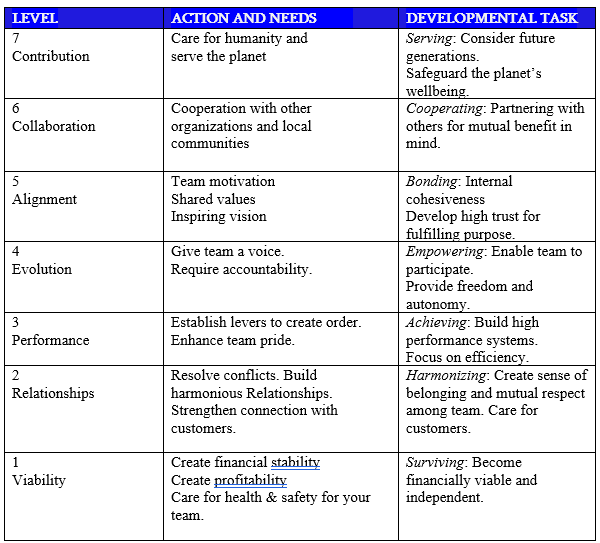
Barrett Value Center developed the standard for the measurement of culture. On a level of 1 to 7, the Barrett Model provides a map for understanding your organization’s values. You can use this model to nurture relationships and align the purpose within your organization.

Each level has action steps that fulfill the organization’s needs, followed by a developmental task that suggests who or what those needs serve.

Your role as a values-based leader is enhanced when you embrace your values and truly start to live them. This tool will ensure all areas are covered.

Visit the Barrett Value Center to learn more about this model.

Be Authentic

The importance of authenticity lies in the shared beliefs and assumptions about you as a leader, providing greater alignment and benefits for higher productivity within a team or organization. This requires setting expectations for how you lead and what is expected of new hires from the start. You will also want to express your values with everyday folks. I also urge you to circle back periodically to stoke the fire of memory so that teams are routinely reminded of what is core to their success.

Even when you need to communicate that you are limited by what you can share, communicate early and often so that people remain in the know and are not left to stumble in the darkness of the unknown. This is a debilitating experience where forward movement and innovation are key drivers to be respected.

Here are some of the results of being a value-based leader.

  • Enhanced decision-making – with clarity, values-based leaders can make decisions that align with the company’s goals while setting an example for their teams to follow. Employees, managers, and leaders work together toward a common goal.
  • Improved communication – open lines of communication are strengthened when you have an authentic leader who isn’t afraid of tackling tough subjects. Values-based leadership leads to enduring relationships.
  • Increased productivity – when leaders encourage personnel to bring their ideas to the table, those employees tend to be more vested in the company’s success. A shared value system is one way to ensure everyone is on the same page.
  • Set up individuals for success – a values-based leader develops others and encourages them to move toward common goals.