Author: Byron Darden

Small Changes Lead to Big Results

Sometimes we get feedback that suggests something needs to change in how we do what we do. In those instances, it is helpful to consider the issue’s root that prompts the feedback to find its way to our front door.

Once you’ve done a root cause analysis – a fancy way of saying what’s causing the problem – you can identify solutions to ensure the problem gets solved and determine steps to prevent it from reoccurring. While it can be a noted effort to tackle, the first step is overshadowed by what it takes to avoid the reoccurrence. That is where your discipline is crucial.

These examples may trigger behaviors to replace, what to do instead, and a quick technique on how you might tackle this change.

Move FromMove ToWhat to Do
Late to meetingsEarly to meetings15-minute calendar buffer
Talk muchTalk lessListen more
Full agendasSpacious agendasLessen agenda items
Work weekendsAvoid weekend workSchedule nonwork weekend activities
No ME timeRegular ME timeSelf-Appointments
Heavy workloadDelegate workloadDiscuss deadlines and workload as a team

Helping Your Team Thrive

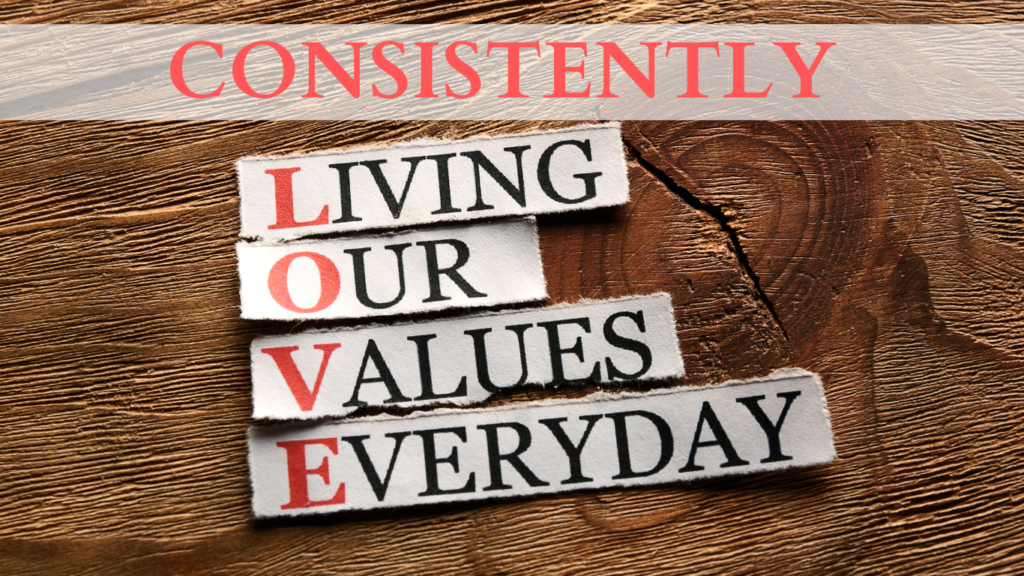
Consistency is essential to your team dynamics. We cling to consistency as it saves time, money, energy, and as much avoidance of anxiety as possible. That is when it does not stifle innovation. It is also a positive quality in your brand persona, given the benefits of its offer of the abovementioned elements.

When we lack consistency, we tend to be less favored by those for whom consistency rules supreme. This allows us to make an informed choice knowing the probability is most likely in our favor with specific audiences.

Here are some more benefits to your team:

  • Being consistent builds trust and respect. Your team can count on you to communicate expectations, follow through on commitments, and demonstrate clear values.
  • Being consistent encourages accountability. As a leader who holds their team in high regard and has instilled a sense of ownership, your team tends to respond with accountability and excellence.
  • Consistency enhances communication. When your team knows what to expect, they can skip to discussing important things about the project and team strategy.
  • Consistency fosters innovation. Without guessing intentions, time is freed up to present new ideas. Leaders who support this trait encourage their employees to take risks and brainstorm different approaches.
  • Consistency supports growth and development. As long as it’s part of the leader’s game plan, time freed up by consistency can be spent on the team or individual growth opportunities, whether training, new tools, or fun, enriching activities.

Balance and Trust

In the marketplace, we tend not to trust when consistency is absent. We hold back and sometimes pivot in a new direction for substantive familiarity. We may prefer to deal with the devil we know rather than the one we do not know. Because of this, the game of consistency tends to rule. The more you can be counted on as a leader, the more comfort you generate for your team.

In a world of impermanence, how do we create balance with consistency? Here are some questions to consider. See how they resonate with putting you in the comfort zone of consistency that seems to count for so much to reach success.

  • Do I communicate my expectations clearly and consistently to team members?
  • Do I consistently demonstrate clear values and ethics in my decision-making?
  • Am I reliable in meeting deadlines and following through on commitments?
  • Do I treat everyone on my team fairly, regardless of background or personality?
  • Do I consistently seek feedback from team members and use it to improve myself and the team?
  • Do I hold myself accountable for actions and mistakes and hold my team members to the same standards?
  • Do I consistently support my team in their professional growth and development?
  • Do I consistently strive for excellence and encourage my team to do the same?

After answering these questions, do you see yourself as a consistent leader? Or are there areas for improvement? Consistency is a skill you can nurture.

Clear Expectations

Employees can perform to expectations when they know what to expect from your behavior. When you constantly change your mind, there is chaos. Consistency brings with it a sense of logic and regularity. These are all concepts we tend to cling to in a life full of change. Consistency has a grounding nature that allows us to deal with change more effectively.

At the same time, when inclusivity is of global significance, it is worth noting that consistency is a form of conformity, seemingly the opposite of showing up as our authentic selves. It may help to see the framing of consistency through the lens of steadiness and uniformity. This adds a sense of stability in which we find comfort in something we can count on while so many things are in flux.

Founder’s Corner

Consistency is the name of the game! – Billie Norris, Writer and Luxury Lifestyle Specialist

As you can see by these images that depict that very concept. In this addition of Leading With Purpose On Purpose we are continuing our series on The Executive VOICE and we are addressing what many of us struggle to do day in and day out and that is to do whatever we do well, regularly!

Particularly when it comes to leading teams, our businesses and ourselves.

In a world of constant change, the only thing that actually remains the same, we are charged with finding a way to nurture an environment where employees, managers and leaders can function knowing that, while change is always taking place, there are some things we can count on. Clients still need what we have to offer. Employees can count on one another to make the effort to accomplish necessary and continually lengthening list of tasks and To Dos. Managers continue to show up to guide their teams through projects. And leaders are counted on to keep the fire burning on the vision for which we work so hard to bring more fully into focus.

The types of things that do tend to remain as a constant are how we show up as leaders. For example, while expectations may change their need for clarity remains. The desire for balance and trust remain paramount. And the ongoing support necessary for the front line of employees and managers are without question, crucial in order to keep the productivity of teams moving down the railroad track into the next station.

There’s an old saying in New England, particularly in the state of Maine, “you can’t get there from here!” Meaning, that when you want to reach some far away location, gaining access can be rather extensive, and the directions can be so complicated, that it leaves some flustered enough to give up. That can sound like a work situation that causes people to quit.

The aspect of complication in this context is the ever changing landscape requiring a break in consistency we yearn for that allow us to get from point A to B. This constant state of flux is all the more reason for leaders to show up consistently creating space to help teams thrive. It could be living up to your personal brand to show up when you say you will and do what you say you will do. That’s easier said than done!

As leaders, maintaining as stable a foundation as possible, helps those we lead stay grounded and confident that they can get the job done and done well, and in most cases, meeting deadlines.

Value of Consistency in Leadership

When we head to the grocery store, we expect (every time) to find our favorite yogurt and snack foods. When it is not there, we experience confusion and head to the manager to find out when or where to obtain our desire. Human nature yearns for predictability– a place to come home to, steady work, an easy commute, a great meal, etc. It’s no different in leadership, where consistency affords employees and peers knowing what to expect and the freedom to act accordingly.

“Consistency is the name of the game.” as one wise friend reminds me well, . . . consistently! Though it may be helpful to determine what game is in question. When it comes to leadership, the game is about becoming and maintaining viability as an organization. The players are of a professional nature as employees, managers, directors, and leaders.

The organization may include a board, where members recommend how people and projects in different positions could most effectively provide the greatest optimization to maintain organizational viability. This context sets the stage most effectively for implementing education to gain the desired outcome.

Founder’s Corner

You’re on a tight schedule. No time to waste and little time to fit something more into your busy life. You race to the grocery store to pick up a few items and race back home in time for your next call. Suddenly you feel the coming of hunger pains. Thank goodness you went food shopping when you did. Although you forgot a few essentials you were planning on to ease those lunch time hunger pains. Does this sound familiar. You’re not alone.

I did a bit of research and discovered that over 50 percent of food shopping is unplanned. What does that say about our intention? Or for that matter, our effectiveness in budgeting groceries. How much time have you invested by not having a grocery list prepared and a clear intention about what you’ll eat? It’s happen to me, so I know first-hand. Yet would you lead a line of business without an intention?

I’m Byron Darden and I want to welcome you to another addition of Leading with Purpose on Purpose. Today we’re going to talk about intention.

I recently attended a fireside chat for woman of color by woman of color. Empowering Authentic Corporate woman. Five women, five inspiring stories that spoke to the need for intentionality when you have your eye on the next executive move you want to make toward the C-Suite in your career. I was inspired by the stories many of these women shared about being a scientist in an environment dominated by men. The challenges overcome by women who struggle with Dyslexia and yet find a way to thrive. The story of increasing representation of black women in industry. And the heartbreaking wakeup call about the distinction between a mentor and a sponsor, the latter of which holds significant benefits when navigating the corporate ladder.

I invite you to take a closer look at who these women are and why their stories matter to us all. And while you’re exploring, take time to learn more about Intentionality. The third installment of my series on the Executive Voice. Enjoy!

An Intentional Journey

“Choose your intention carefully and then practice holding your consciousness to it, so it becomes the guiding light in your life.”
— Roger Delano Hinkins

To some, living and speaking with intention comes naturally. For others, there are challenges due to limiting beliefs, past experiences, imposter syndrome, and more. Our stories define our thoughts, feelings, words, and actions. Becoming intentional brings clarity.

It takes time to figure out what drives you and translate that into your behaviors. Rest assured that you are not alone in your journey. Through the years, I, too, have gone down this path, and I have a strong sense of how you might feel. I aim to help executive women like you and other high potentials for leadership positions navigate the sometimes-murky waters of the corporate world.

Together we can discuss intentionality and other leadership skills to help you thrive with your team and in life. Book a call to discuss your situation and see how I can help You become a leader with purpose on purpose.

Set Yourself Apart

According to a recent Gallup poll, only 33% of American workers feel engaged in their work, and one of the primary reasons for this is their boss. We have already spoken of the importance of employees needing to be heard. Employees want the freedom to express their creativity, and they want to work for a leader who instills confidence and has their back. An intentional leader guides without holding anyone back.

Having one-to-one meetings with your team members also allows for curating their intentionality. Show up with a well-thought-through plan that involves concrete steps. Set goals together, and as a basis, answer three questions for each goal – what, why, and how. Encourage your team to think about these steps as well. This will create engagement as well as build an intentional relationship.

Think, Say, Do

As a leader striving to be more purposeful, you want to remember a few things. To get the engagement, we will want to put forth the effort. A keynote speaker rarely speaks off the cuff. They may allow room for improvisation at specific points in their presentation. Yet most improvisation is carefully rehearsed in our intentional preparation for thinking on our feet, being in the moment, and simply remaining present to whatever is around us. That way, we can easily use the world around us because we are steeped in the present moment.

When you strive to be a more intentional leader, think about development in these areas:

  1. Approach each situation with a clear mission, goals, objectives, and priorities: Know the big picture and why your team should care.
  2. Control the speed of the decision: Ensure you have the facts and opinions of others before making a final decision. This is where you give your team a say and get buy-in. This is also a time when you shine. It’s perfectly acceptable to step back and clarify details as needed rather than heading off in a direction based on the heat of the moment.
  3. Keep lines of communication open: Conversations and relationships among your team ebb and flow. Emotions, feelings, and thoughts all factor into the process. As an intentional leader, you are aware and react with mindfulness.

My parent company is Triple Axel, the name of a jump in figure skating and adapted to a triad of what you think, say, and do. According to Consultant and Business Coach David Meltzer, these are three of the five levels of intention. Let’s take a look at them.

  1. What you do: Follow up with actions and ensure those actions align with your feelings, beliefs, thoughts, and words.
  2. What you say: Becoming intentional with our words is about controlling their impact. Consider how the recipient might respond. Say what you mean and mean what you say.
  3. What you think: Beliefs lead to the formation of thoughts. We have many thoughts each day; not all are positive or helpful. Intention lies in sorting these thoughts and controlling which ones come from our mouths.
  4. What you believe: Beliefs are formed from feelings and our personal experiences. We have underlying subconscious beliefs that serve as our guide and limiting beliefs that do not serve us. It’s essential to examine our beliefs to discover how valid and valuable they truly are.
  5. What you feel: This is your intuition – that ache in your gut that screams, “Run!” or “Go for it!”. When we learn to listen to our gut, we can connect to our inner guidance.

Intentionality seeps through into each aspect of our leadership experience. Not only do we strive to become intentional with our feelings, beliefs, thoughts, words, and actions, we can cultivate these in our employees. We do this by creating a culture of continuous improvement. Here are a few ideas to put this into action.

  • Lead by example: Set your intentions and encourage your team to do the same.
  • Communicate regularly: Be clear in your requests and ask for input from your team. Encourage participation from all members.
  • Empower employees: Happy employees are the ones that feel heard. Be aware of your team’s thoughts and feelings and address issues as they arise.
  • Small steps lead to big success: While focusing on the big picture, it’s essential not to forget the process. Minor, incremental improvements are critical to the end result.
  • Celebrate successes: Results achieved through continuous improvement should be celebrated.