Author: Byron Darden

Where Do You See Yourself?

Think of your life in four increments of 8000 days (22 years). Each 22 years is a chapter that reads like a book. A time in your life during which you will transition to another. By the time you finish The Book of You, How would you want each chapter to read? 

Here is an activity you can start with:

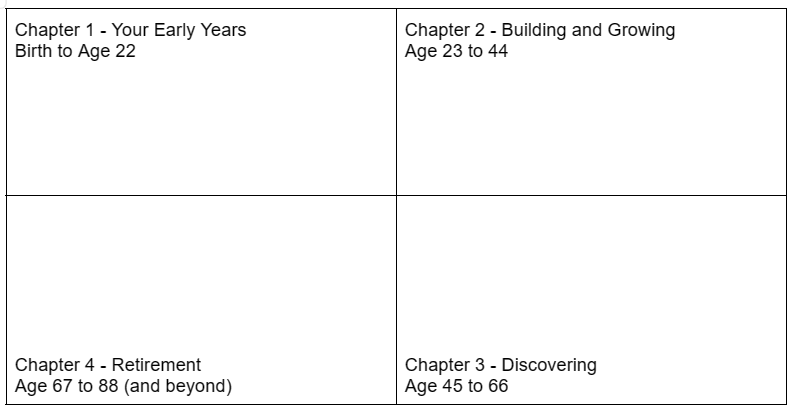
Create a Four Square chart: The Book of You

Proceeding in a clockwise direction, starting in the upper left, name the boxes chapters 1 through 4. Identify each chapter by a name that is most meaningful to you and captures the general activities you recall taking place in the first two (the chart below has examples). 

Remember that the first chapter takes you to the age of 22. 

While the second begins at 23 and ends at 44 years of age.

Now imagine your future self in Chapters three and four. 

What name would you give each of the two remaining chapters?

What types of activities do you imagine being your focus? 

What do you like about what you see? What would you like to change? 

How do you imagine you would go through that process?

Let me share A Personal Breakthrough.

A Personal Breakthrough

In 2008 I stepped into my first ever experience of Life Planning. It was an eye-opening experience for me to stop and consider what is most important to me in my life. I was coached through the various steps involved in the process and what I discovered was surprising.  

At the deepest level of my life plan was the desire to be philanthropic, self-improvement-focused, and able to give back to others. When it came to how that would look, creating a business, publishing a book on how to thrive, and public speaking were at the top of my list.

What came out of that life plan was starting Triple Axel Executive Coaching, publishing a blog, and beginning to deliver keynote addresses. I also returned to my acting roots and was approached by long-term friend and theater director, Jane Staab. She cast me in Billy Elliot: The Musical. I left my home in New York City and relocated to Boston in 2017 to begin rehearsals and launch the production. It was an exciting time and a challenging one on a personal level.

Halfway through the run, my father’s health took a turn for the worse. On a Sunday evening following a matinee performance, I took the last flight out of Logan Airport before they closed due to a snowstorm and traveled to my father’s bedside in Denver. Two days later I flew back to Boston in time for a 10 am matinee the following morning. Upon my arrival in Boston, I heard from my sister that our father passed away.

I realized that as part of my life planning, I’d become closer to my sister, took time out to support my dad during his five-year illness following a stroke, and was impacting the lives of others through my performance on stage. That is when I discovered how powerful life planning can be.

Years later, I was reintroduced to Life Planning while attending weekly meditation with the father of Life Planning, author and retired financial planner, George Kinder. Two years ago, I began taking a deeper interest in Life Planning and decided I wanted to help executives by introducing them to this life-changing experience as it had been for me.

One of the other surprising revelations for me is that within my first Life Planning experience, I’d covertly alluded to becoming a Registered Life Planner myself. So I committed, signed up for the course, and did the training. What I had not expected to learn was how prepared I was to step into this work from all the previous work I’d done in becoming an Executive Coach that began over twenty years ago.

What I learned from this experience is that Life Planning and Executive Coaching go hand-in-hand. My certification in Organizational Change Management was also inextricably linked to who I am becoming in my field; an influencer in how the world of business runs.

Find out What You Gain from life planning.

What You Gain

You may be familiar with life planning as it pertains to the end of your life here on Earth. You draft a will and decide that your china collection goes to your daughter or son.  We want to differentiate that from life planning, which is a plan for your life. It entails what you want your life to look like and how you are going to accomplish your vision.

Many of us set goals related to promotions or working until we are 67 ½ and then retiring. It’s easier to achieve a goal of $1 million in our bank account than it is to envision a better relationship with our partner or leave a legacy.   

Around 22% of people have end-of-life plans. Around ⅓ of people have life plans.  Some of us make plans for exercise, healthy eating, and our career aspirations, yet life planning is so much more. It’s been compared to a personal compass.

Of those who create and work toward their life plans, there is more focus and commitment. Among the benefits of a solid plan are:

  • Helps you direct your energy and resources toward specific objectives.
  • Prioritize your tasks and goals based on their importance and urgency.
  • Allocates time for various activities and tasks, including work, leisure, and self-improvement.
  • Motivates by visualizing your goals and the steps needed to achieve them.
  • Creates accountability when you share your goals with others.
  • Allows for flexibility when life is unpredictable.

It’s time for you to Take Control.

Take Control

“If you don’t design your own life plan, chances are you’ll fall into someone else’s plan. And guess what they have planned for you? Not much.” – Jim Rohn

Are you tired of living life on someone else’s terms?  

Perhaps you made choices that achieved your professional goal, and still something is missing.

At Triple Axel Executive Coaching, we coach you through the corporate dilemmas in which you find yourself – how to get to the next level or how to effectively lead your team.  Along the way, you discover more about yourself. Perhaps you find that your purpose doesn’t align with your job role. You may also find that you are exactly where you need or want to be and now have the clarity and confidence to move forward.  

Asking yourself how you want your life to look and feel are essential questions for your quality of life. You might sit down and envision a life filled with community involvement and relaxing breakfasts with your partner. Your reality might be 80-hour work weeks that start with 6 am power meetings.

Getting from your current reality to the life you envision is what life planning entails. I’m Byron Darden, founder of Triple Axel Executive Coaching and a Registered Life Planner RLP®. Book a call and we’ll start getting you from here to there in a way that works for you.  

Founder’s Corner – The AHA of Change

Catherine Pulsifer is a published author who shares the many hurdles she overcame in her professional career. She has a beautiful quote that says, “One of the best lessons you can learn in life, is to master how to remain calm.” I recently attended a nine day silent meditation retreat where calm was a huge takeaway for me. I also experienced deepening concentration and focus. I had greater access to insights far deeper than I recall ever having before. It put me in touch with the countless women who have contributed to shaping my life and my work. And with that we celebrate March beginning with Women’s Month.

As secondary celebrations this month there’s also National Nutrition Month. Employee Appreciation Day and National Day of Unplugging, both celebrated on the 1st of March. Although I look at these one day celebrations like birthdays. Celebrate them all month! I encourage you to do the same. There’s also the International Day of Happiness.

What’s significant about these celebrations to Triple Axel Executive Coaching? For one, the majority of my career has been centered on women. So this month is particularly special for me. When it comes to nutrition, Joe Bastianich who’s an American restaurateur and winemaker says, “When I stopped looking at food as a reward or celebration and began looking at food as energy to fuel my athletic ambitions, that really kind of changed the whole world for me. That was the real AHA moment.” I love that quote because it really speaks to another quote I love which is, “When you change the way you look at things, things change.”

I unplugged for 10 days in honor of the National Day of Unplugging and in celebration of it. Then there was the International Day of Happiness which is what this retreat really led to for me around personal restoration and having a greater sense of happiness.

Hi I’m Byron Darden welcoming you to another edition of Leading with Purpose on Purpose. In this installment of our continuing series on Transitions we focus our attention on The AHA Moment of Change. You know, my greatest continually evolving AHA is what I learn each month as I prepare my blogs for publication. It is my hope that you will learn just as much as I did.

Enjoy.

Click here to discover Moments of Clarity: Discovering the Power of AHA.

Moments of Clarity: Discovering the Power of AHA

In our lives, some moments stand out – times when everything clicks into place. We see things with a clarity that eluded us before.  These “AHA moments” have a unique ability to shape our understanding and set us on paths of self-discovery.

This month, we’ll uncover the essence of AHA moments—from subtle insights to profound revelations. Whether in groundbreaking scientific discoveries or personal experiences, these moments transcend boundaries, leaving a lasting impact on our lives.

Join us as we delve into the origin and impact of these transformative moments, exploring the dynamic relationship between intuition and intellect. From historical turning points to personal growth, AHA moments are the sparks that ignite our quest for knowledge and understanding.

Get ready for a journey through the landscapes of revelation, where the boundaries of what we know are expanded, and moments of sudden clarity redefine our perspectives. As you join us, take a moment to reflect on your own AHA moments, recognizing their profound influence on the human experience.

What are these AHA moments? Continue to Insights and Emotional Realizations.

Insights and Emotional Realizations

An “AHA moment” is more than just a serendipitous flash of insight; it’s a powerful catalyst for change, a sudden and unexpected emotional realization that ushers in a deeper understanding or a fresh perspective. These moments of clarity, often accompanied by a profound sense of enlightenment, have the potential to reshape our thinking and propel us toward growth.

For many of us, AHA moments seem to occur organically, catching us off guard with their sudden impact. They manifest during times of reflection or in the midst of navigating challenges, offering a unique lens through which we can view a situation or concept. These unplanned revelations have the power to shift our perspectives, leading to a newfound clarity that can be transformative.

Contrary to the belief that AHA moments are solely products of happenstance, they can also be intentionally cultivated. Choosing a deliberate path, committing to collecting data, and planning for an AHA in advance are strategies employed to engineer these moments. Consider the metaphor of the overnight sensation in the entertainment industry – an actor strategically planning and executing steps to seemingly burst onto the scene. Likewise, the self-made millionaire meticulously plans and adapts, implementing backup strategies when faced with unexpected challenges.

In the pursuit of our goals, unexpected obstacles often force us to activate our ability to think on our feet. Spontaneity becomes crucial as we navigate changes in direction or unexpected shifts in our plans. Pivoting becomes a necessity – a skill honed through adapting to choices that might not lead us exactly where we initially expected.

AHA moments are, at their core, emotional reactions. By understanding the emotional journey users undertake, intentional AHA moments can be strategically crafted, enriching the user experience and fostering a deeper connection.

How does the brain and technology work together to create AHA moments? Learn more about The Eureka Effect.

The Eureka Effect

Termed the “Eureka effect,” AHA moments are closely associated with sudden realizations that lead to breakthroughs. This phenomenon is not confined to personal experiences alone; it permeates various fields, including technology. A closer look at intentional AHA moments in technology reveals how emotions play a pivotal role in these breakthroughs. The intentional creation of AHA moments for consumers, as explored in the realm of technology, showcases the profound impact that planned insights can have on user experiences.

When the connection between the heart and the brain joins forces with the body in a fluid state, the outcome is what is called the eureka effect. The bright idea emerges. It’s about being in alignment with your purpose. This is the moment when our mind, body, and soul calibrate with one another, leading to more idyllic circumstances. Think of it in terms of the brain receiving signals from the heart that together fall into synchronicity with our physiology (functional body parts). 

Of course, our educational experiences, our ability to think critically, and our understanding of data and science are all significant and essential elements that give us the framework to articulate, define, and execute our vision. Yet the epiphany emanates from the heart and is fueled by its intuition. True visionary leadership develops inside the heart, not the brain. And it is there for each of us to grasp…we simply need to be aware of how to access it. Access is the key to getting to the heart of what is important. Then we are more effectively able to understand why its importance matters.

Set yourself up for more AHA moments in AHA’s are No Accident.

AHA’s are No Accident

Discovering those “AHA” moments, those sudden realizations that reshape our understanding isn’t a stroke of luck. It’s about actively setting the stage, showing up, paying attention, doing thorough research, and taking note of the outcomes.

Moving from rigid thinking to embracing possibilities defines The Executive VOICE. It’s about being open-minded, actively participating in the process of learning, and setting the scene for those transformative “AHA” moments. Check out the February 2023 blog to learn more.

Embracing Open-Mindedness: Key Traits

Open-minded individuals share distinctive characteristics:

  • Willingness to Challenge Ideas: They welcome challenges, seeing them as opportunities for growth.
  • Calmness in Challenges: Even when beliefs are challenged, they stay composed, understanding the value of humility in growth.
  • Empathy: They genuinely care about others, even when perspectives differ.
  • Thinking About Others: Actively considering different perspectives.
  • Humble Knowledge: Acknowledging there’s always more to learn.
  • Desire to Listen: A genuine interest in hearing others’ thoughts.
  • Belief in Sharing: Everyone has the right to express their beliefs, fostering inclusivity. Otherwise, the authoritarian alternative risks minimizing potentiality.

Benefits of Open-Mindedness: Mental and Emotional Gains

Cultivating an open mind brings mental and emotional rewards:

  • Insight into Diversity: Understanding different beliefs, lifestyles, and cultures.
  • Heightened Empathy: Ability to empathize even when common ground is scarce.
  • Enhanced Self-Reflection: Thinking more deeply about personal experiences, thoughts, and decisions.
  • Confidence Boost: Increased confidence in one’s beliefs, rooted in continuous learning.
  • Mental Strength: Building resilience and reasoning skills.
  • Realism and Optimism: Balancing realism with optimism.
  • Honest Expression: Encouraging honest communication about emotions with others and oneself.

Embracing open-mindedness transforms how we think and enriches our relationships and overall well-being. It expands the possibilities for “AHA” moments, making them a regular part of our journey.

Find out how to discover new AHA moments by Opening Your Mind to New Ideas.

Opening Your Mind to New Ideas

In the dynamic journey towards open-mindedness, arming yourself with effective tools and adopting practical tips can pave the way for transformative shifts. Here are ten actionable steps to become more open-minded:

  1. Be Aware of Your Biases: Acknowledge and confront your biases head-on. Understanding where your predispositions lie is the first step toward overcoming them.
  2. Consider the Opposing Viewpoint: Actively engage with perspectives that differ from your own. Particularly with clients and team members. This broadens your understanding and fosters a more inclusive mindset.
  3. Practice Generous Interpretation: Assume that people have positive intentions. Cultivating a positive outlook enables you to approach discussions and disagreements with empathy.
  4. Ask Questions: Be curious. Asking questions encourages dialogue and allows you to gain deeper insights into diverse viewpoints.
  5. Think About the Neutral Viewpoint: Deliberately consider perspectives that fall in the middle ground. This helps in fostering a balanced understanding of various issues.
  6. Make New Connections: Expand your social circles and professional networks. Interacting with a diverse range of people exposes you to different ideas and experiences.
  7. Experience Different Media: Diversify your sources of information. Consuming a variety of media ensures a well-rounded perspective on current events and issues.
  8. Join a New Group: Participate in activities or groups that are outside your comfort zone. Engaging with new communities introduces fresh perspectives.
  9. Reframe Negative Thoughts: Transform negative thoughts into constructive ones. This shift in mindset contributes to a more open and positive outlook.
  10. Acknowledge You Are Learning: Embrace the fact that learning is a continuous process. Acknowledge that your beliefs and understanding can evolve with new information.

Exercise: Inspiring “AHA!” Moments

Unlocking those coveted “AHA!” moments involve intentional exercises that encourage a shift in focus. Here are strategies to inspire moments of insight:

  • Zone Out and Focus In Spend time in solitude, focusing on your inner life of physical sensations. Eliminate external stimuli to allow yourself to let go of thoughts to get in touch with what you are experiencing. One way to accomplish this is to spend time out in nature. This will foster an optimal environment for present-moment freedom.
  • Allow Your Mind to Wander: Embrace wandering thoughts. This seemingly unstructured mental state often triggers insightful revelations and connections.
  • Avoid Overscheduling Your Day: Create downtime in your schedule. Allowing moments for daydreaming fosters a creative space where new ideas can flourish.
  • Foster Happiness: Cultivate happiness in your life. A positive mindset provides the mental space for insights to emerge, leading to eureka moments.
  • Lift Your Spirits in Low Moments: When feeling under the weather, engage in activities that uplift your mood. Whether it’s reading an inspiring book, going for a walk in nature, or spending time with a friend or supportive community, these actions contribute to a brighter perspective.
  • Take a Necessary Nap: Recognize when you need a break. A short nap can rejuvenate your mind, promoting mental clarity and openness to new ideas.

By incorporating these practical tools, tips, and exercises into your daily routine, you can actively cultivate an open mind and create an environment conducive to those invaluable “AHA!” moments. Think of engaging in these activities as restorative self-care.

Let me tell you a story in Navigating Transitions: From Setbacks to Breakthroughs.